Search This Blog

Saturday, 6 August 2011

Pruning at Blueskin

This weekend in Dunedin we were warned there would be snow on the hills which would be enough to keep most people in bed early in the morning, yet I fought the cold air and made my way out to Blueskin nursery to learn a thing or two about pruning.


Blueskin nursery is 20 minutes north of Dunedin and has won a number of awards as an outstanding gardening centre. It is owned by Mark and Clare Brown and has been in operation for 21 years. I arrived and it was brisk but sunny and I sat down on one of the chairs put out in front of an array of fruiting plants. The session was hosted by Mark Brown and he began by introducing the group to gooseberrys. I was very tempted into buying one of these plants as I have never eaten a gooseberry but the bank balance said "No!" so I might put it to the back of my mind just now.  He used the gooseberry to demonstrate how to create a standard. 

To create a standard you select a strong centrally upright leader and remove all other stems. This leader should be trained up a stake to a desired height while removing side shoots after each growing season, you can do this by actually digging your thumb nail into the stem and removing the whole bud. Once the leader has grown to the desired height the top bud should be removed (to promote bushy growth) and the strongest three to five side buds left to create the plant.


Standard Gooseberry


He then went on to demonstrate how to prune berry bushes. He started out with a blackberry demonstrating that the best way to prune was to cut the old wood out at the base of the plant ensuring that the middle of the plant gets lots of light and ventilation. Blackberrys fruit on the wood from the year before however in the case of red currants the fruit is found on wood from two years ago and hence is harder to keep track of. A little handy hint he gave us to help with this was to cut the wood as you collect the fruit that way you are only removing the old wood that has fruited. 

He then moved on to apples showing us how to train them into a espalier. This first requires that you create a training system up whether it be wires or a wall. The leader is trained upright to the first wire and then the top bud cut to promote two sideways growing shoots. Once these side shoots are long enough they can be trained along the wire ensuring that the tip of each shoot is the highest point of the plant otherwise growth will begin in the middle of these shoots. A shoot will also begin to form where the first cut was made and this should be trained up to the next wire and the process continued.


Espalier Apple


This was particular helpful as I have 3 apple/crabapple trees on my section that have been roughly trained into a espalier shape although have been somewhat neglected for a while now. After the session I took to them for almost an hour trying to correct their unruly shape, I even had the hacksaw out. I may regret this at the end of this season as there is not much wood left for apples to grow on yet,  I am sure this hardwork will payoff in the coming years and I will finally be able to make something of my apples which so far have gone to waste.

Last on Marks list was to tell us about grapes. He told us about the old wives tale that says to bury a sheep underneath a freshly planted vine (for all these years I had thought it was a cat, a nasty Blakie story perhaps?). He told us that grapevines put out very deep roots and hence by making a hole that could fit a sheep you were ensuring that the roots had somewhere to go. Once again the theory behind grape growing was to train the vine to a certain height and then to prune you cut to a bud on the main part of the plant. He told us that grapes don't like wet feet but the do wonderfully in Otago provided they are planted in a spot with lots of sun. If you are having problem with fruit drop he said it was usually due to early frost that had weaken the developing fruit in the early stages.

The most important things I pulled from this session was the harder you prune the more you are going to force the plant to create new growth. Also that you should prune to ensure that the plant gets enough light and by pruning to the bases of branches rather than just taking the tops of branches you will get a much healthier and compact tree. Whether or not my apples are a success I don't know but I certainly will be attending more session like this one at Blueskin nursery.

Field of Flowers

If you have a spare paddock or two you could create your very own living Monet!


That is exactly what a couple in Somerset have created. Brian and Denise Herrick have taken 57 different species of annual flowering plants and painted a scene they call a field of dreams.


The seed mixture was designed to produce a sequence of brightly-coloured flowers through July and August (Northern Hemisphere). Among the earliest blooms were daisies, including the white Cape daisy and the delicate clusters of the Swan River daisy. These were followed by the blue-and-white Morning Glory, blue larkspur and poppies, including the California poppy.


Wednesday, 3 August 2011

Flower Power


In 1922, Canadian scientists isolated insulin for the first time. Since then scientists have genetically engineered several organisms that over produce human insulin. However insulin is still expensive and with the demands of insulin only going up due to the increase in diabetes around the world a cheaper option is long overdue. The answer may have been found in plants.

Scientists at the University of Calgary have genetically engineered the human gene for insulin into the common plant safflower. Once the gene is turned on within the flower, the flower begins producing insulin faster than traditional methods that utilize pigs, cows, yeast, or bacteria.


This is the first instance of a plant producing the insulin, and it does so prolifically, to the tune of roughly 1kg of insulin per acre of flowers. At that rate, 40 square kilometres of safflower could produce enough insulin for the world's entire diabetic population.


Monday, 25 July 2011

Stings, wings and hairy things - Bee by Rose-Lynn Fisher

Do bees really have knees? According to artist Rose-Lynn Fisher's new book BEE, they do. Using a scanning electron microscope, Fisher has taken 60 photographs of bee anatomy – at magnifications of up to 5000 times and I have just received my copy of the book! I have been waiting for 2 months for it to be delivered from the States as a birthday present from my brothers and it was well worth the wait the pictures are glorious. Pictures are below with quotes from the book. 


Sting in the tail 650x 


"The sting is actually a modified version of an ovipositor, the queen bee's organ for laying eggs. A honeybee will sting only in self-defence or in defence of the hive. When a bee stings a person or other mammal, the barbs of the sting become anchored in flesh, and as the bee tries to free herself she dies."  


Drone's wing 10x 

"The drone's sole purpose in life is to mate with the queen. Once he has accomplished this, he dies. Because mating takes place in flight, the drone has evolved powerful wings to pursue the queen. They can even fly backwards. All bees have two pairs of wings, which they beat at up to 230 times a second. The heat generated by the wing beating evaporates water from the nectar in the honeycomb and thickens it into honey. It's also what produces the bees' buzz."  


Elliptical dome of bee eye 190x 

"This is the eye of a honeybee. It's hairy, unlike the eyes of most of the 20,000 species of bee that exist on the planet today. The eye is composed of thousands of hexagonal lenses, which capture light at different angles and detect movement. Each lens is sensitive to ultraviolet light, which can reveal markings on flowers that are invisible to humans but inform the bees where to land in order to find nectar."  


Antenna pollen 1100× 


"A foraging honeybee gets dusted with pollen as she travels from flower to flower. This is a photo of pollen trapped in the hair on the bee's antenna. Bees use their antennae to smell, taste, hear and detect changes in temperature, vibration, wind and humidity. Set into sockets on the head, the antennae pivot freely." 


Secluded Sanctuary

When I first arrived in Galloway Street early January 2010 a section of the garden that was down the back had a large vege plot. Although the only thing that really grew in this vege plot was weeds so it began to look quite untidy. The best option at the time I thought was to get rid of it and replace it with grass so my partner and I spent a weekend weeding, removing the border, flattening the area and sowing grass seed. 


Before (during summer)


After (winter)

However it is quite damp in this area and in addition this is where the bees are now housed so mowing these lawns with a push mower is a bit of a mission to say the least. Although I am yet to fix the boggy ground by planting a more shade loving grass seed I have created a garden bed that will one day make a nice backdrop for this area. I transplanted from other parts of my garden two hydrangeas and a mexican orange blossom along with some forget-me-not seedlings I found loitering in my upstairs vege plot. I then had a thought that I could fill the last spaces with arthropodium a lovely native grass that flowers during the summer and does nicely in sun or shade. After receiving my 12 root divisions bare rooted via the post I put them in the ground. However a week later I came down to mow the lawns and found that some of the plants had been removed. I need to explain now that this part of the garden is semi shared with the neighbours next door however I do have my side and they have theirs. However I think while one of them was tidying up their section they mistook the arthropodium plants as weedy agapanthus and have pulled them out to stop them spreading. I am little annoyed to say the least, but I have a soft spot for my neighbours as they are old, quite cute and I am sure no harm was intended so I will just let it be. However watch this space, in the next few months I am sure these plants will flourish and I will soon have a lovely section amongst the natives (kowhai, pseudopanax and arthropodium) where I can sit and feel completely cut off from city life.


Arthropodium - Renga Renga Lily

Sunday, 24 July 2011

Winter Wonderland

After a wonderful weekend in Invercargill celebrating the engagement of my partner's brother and girlfriend we had the rather challenging task of travelling back to Dunedin after a good 20-30cm of snow had fallen Sunday morning. It went all pretty smoothly until we got to Galloway street where it got a bit slippery. After sliding into the gutter we unpacked and began to marvel at the whiteness. My garden had been transformed into a magical fairytale. 


Sitting in a bed of white - Hyacinth in bloom 


The wintry blast has blanketed Dunedin

Woke up this morning to find this little begger hunting around on the bird table for breakfast. Also found that the sugar water had been emptied and after 3 minutes of putting it back on the table the silvereyes, tui and bellebirds had made the discovery.


Greenfinch


Bellbird


Silvereye


Tui


Cheeky Chubsters


Thursday, 21 July 2011

Big on Birds

Since I was a child I have been fascinated by birds, yet there were never many birds in the garden at the house I grew up in. We had cats and a dog that would always manage to scare them off. However since moving to my home in Mornington, Dunedin I have been able to enjoy the vast amount of birdlife that New Zealand has to offer. My house is situated within 1 kilometer of the town belt, a strip of land that is protected by the council and provides a safe haven for birds including the Kereru, Tui and Bellbird. This means that I am lucky enough to have regular native visitors.

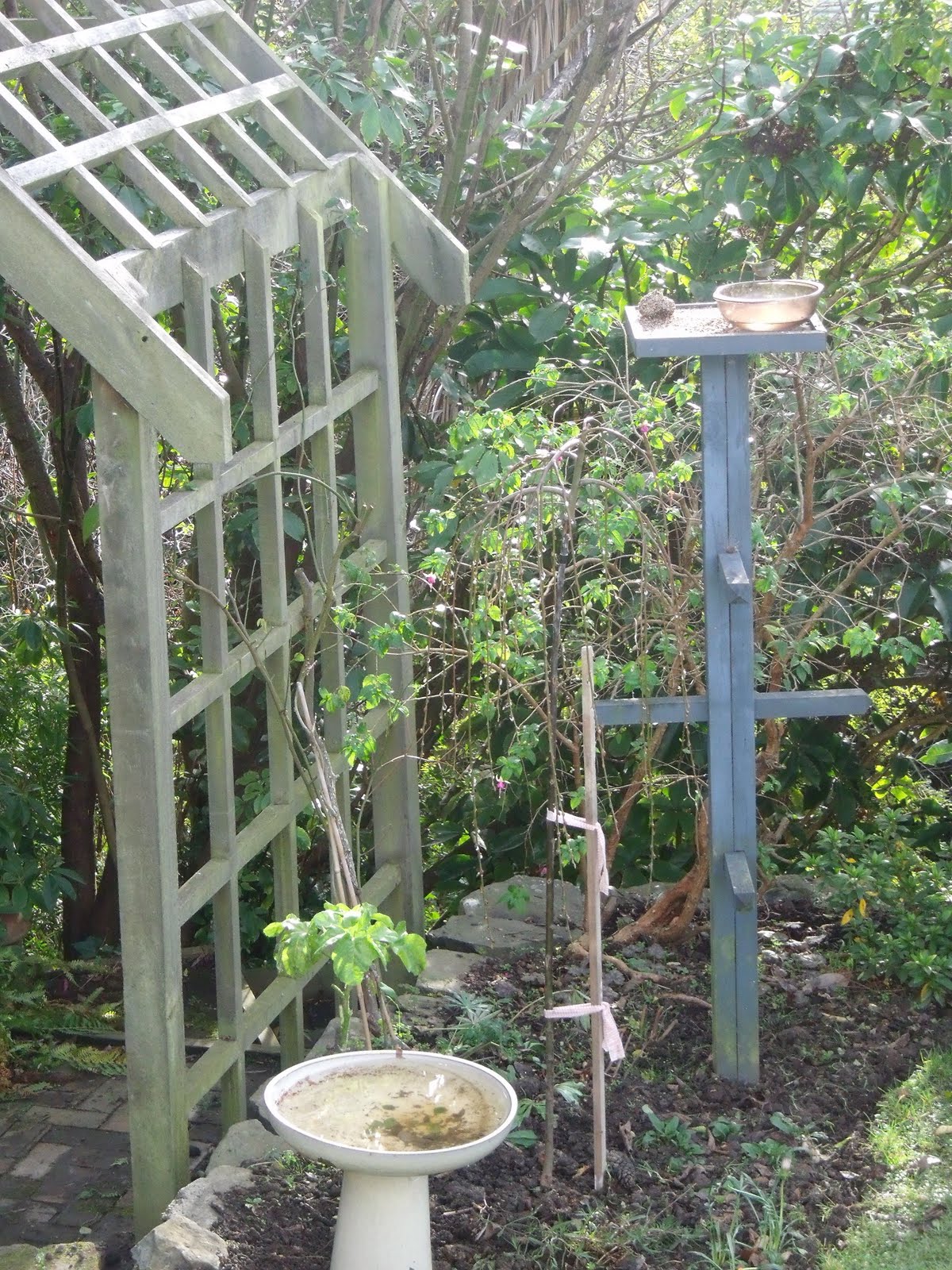
My partner (who wanted me to add a pic of himself being silly) kindly made me a bird table and in winter when I put sugar water out I encourage large flocks of birds into the garden, I find that I am having to put a litre of sugar water out everyday. 


shake your tail feather


beaut bird bath

thomas


There is sometimes upwards of 30 silvereyes in my cherry and pseudopanax trees and I can almost always hear the beautiful bellbirds song. I do however have to be careful when putting out seeds for the birds. They are so messy, they scatter the seeds from one end of the garden to the other so I am always finding little grass and grain seedlings popping up here and there.


It seems as though there are many people around New Zealand that are just as keen on birds as I am. More than 2000 surveys for  the 2011 Garden Bird Survey by Landcare Research have been completed recording the presence of 125 unique species of bird and the preliminary results from 1445 of these surveys have been published on their websiteThe long-term aim of the survey is to determine trends in bird numbers over time. 

Interesting stats about the number of silvereyes visiting gardens this year have emerged from the survey. From 1445 survey returns processed to date, the average number of silvereyes was less than half the number counted last year (6.5 compared with 13.2 per garden). Survey participants made comments such as, ‘Where are all the silvereyes?’ and ‘The lowest number of silvereyes we’ve had in years’.

The website puts the decrease in silvereye visits down to the mild winter the country has experienced this year. "The lack of snow and frosts may mean there is still plenty of natural food around, so birds have not been forced into gardens in search of food". 

.
The website also noted that 'there are some spurious results such as piopio, which will be deleted when the data are edited". Curious considering that the piopio Turnagra capensis, also known as the New Zealand Thrush,  is now extinct.